Author’s note: This began with an onboarding session. It’s a look at what I’m asking someone to learn as we bring AI further into our work, while we’re still figuring parts of it out. — Scott Reyes
What does it mean to be AI-native? For Envoy, it means assigning well-defined, repeatable tasks to AI and AI agents, while people do the work that people do best: work that requires connection, nuance, and critical thinking.
We believe that AI is expansive. One person, combined with the right AI tools, can be as productive as a team of 10 people. Because of this, we integrate it into everything we do as a company. Personally, I work with ChatGPT (using its in-app browsers) more than I do in any other software on my computer. I'm constantly testing the best models and the newest offerings to identify how they might be helpful for my workflow and assist me in building features for our customers and tools for our team.
Almost three years of working this way has changed the way we approach hiring and onboarding at our company.
Imagine the following scenario: I'm onboarding a new customer support specialist to our FM Agents team. We didn’t hire him for his expert experience in work order management software or facilities maintenance operations. We hired him because we saw an engineering-minded systems thinker with leadership potential.
His role will include customer support, software QA, and working with me on product decisions regarding the features we build and implement into FM Agents. Although he is the first person we’ve hired specifically for FM Agents, he’s joining a team of AI coworkers who also perform QA, answer product questions, and help with customer support.
Needless to say, onboarding looks very different now than it used to.
Before, we sought subject matter experts to reduce the time it took to transition from new hire to productive team member. Now, because we have extensively documented our processes and workflows, we only need to familiarize new hires with the concepts and tools they’ll be working with, thanks in part to a digital team of experts to rely on.
When building teams, we use AI agents for well-defined, documented, repetitive tasks, while people focus on designing systems, human communication, and projects requiring nuance, critical thinking, decision-making, and connection.
Based on this framework, here's how our new hire’s team will look:
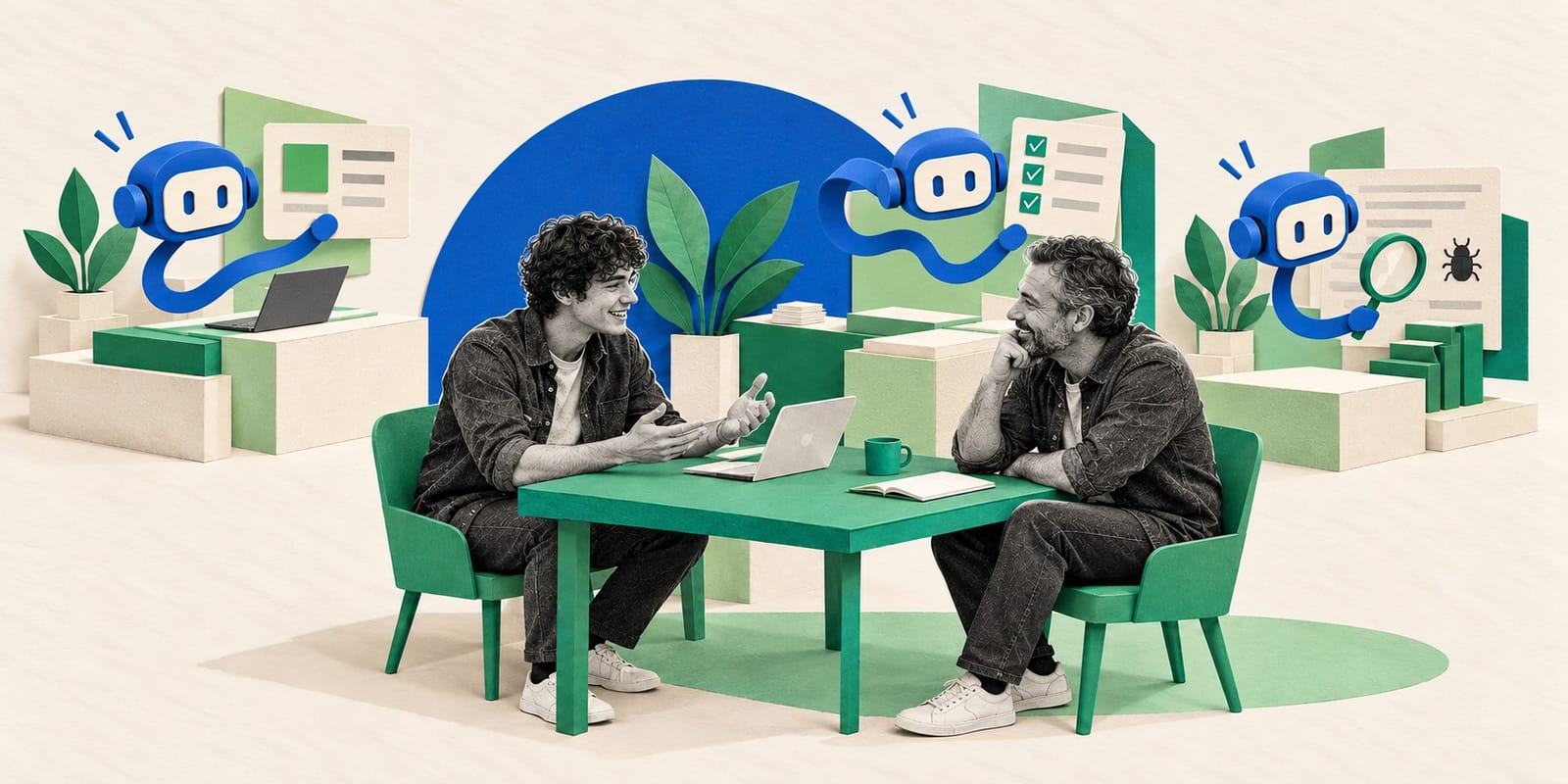
AJ is a Grok Bot that has read-only access to the FM Agents code base. He answers questions about how to use the software by looking at the code and turning it into simple step-by-step instructions or explanations.
Avery, another Grok Bot, performs QA on new features that ship to our staging server. It uses a browser to access our software and report bugs or pass the QA on to human review if everything works correctly.
Alex, who lives inside a project folder in ChatGPT, watches Basecamp for new bug reports that show up when customers submit support tickets. It troubleshoots the bug, then creates a plan to fix it and notify our development team. (I'm planning to move Alex into Grok Bot so he can have his own computer.)
This may leave you asking, “What's your new hire going to do?”
Well, he's going to be freed up to talk to customers about their concerns and questions, and help shape the roadmap for FM Agents. If we didn't have his team of Grok bots, he would spend countless time on QA, watching Basecamp for bug reports, and using the software to try to understand how things work.
This is why we say that in an AI-native company, hiring one new person is like hiring a department.
Here's what I said in my follow-up email to him:
“Treat your Grok Bot agents like expert coworkers who can work with you and train you throughout the day while you learn our software and processes yourself.”
Remember, AI is expansive. Imagine what a person can do when they are free to delegate specific outcomes built on top of clear processes to a team of workers.
What I want him to grow into

The reason we originally decided to hire this person is because of this story he told in his interview about what he likes doing in his free time. He loves working on motorcycles, specifically putting them on a dyno machine to see how he can get the maximum amount of power out of them.
He didn't have access to software that could help him make the types of adjustments he wanted, so he started building one with the AI tools he had access to.
I want him to bring that same curiosity from his motorcycle-software idea to our processes. As he learns the work, he should begin noticing which steps are repeatable, where his judgment matters, and what an agent would need to handle more of it. Then he has to check the result and improve the instructions. I want him to learn how to design processes and manage workers.
He should be able to answer, “How can I make this process work reliably, and what can I do with the time that frees up?”
I care about both parts of that question. I have already spent enough time keeping earlier agents running to know how much work the tool itself can create. The process has to actually work and be worth what it takes to keep it working. Ideally, he should be thinking about what else he has the capacity to take on.
A big part of that understanding for him will come from our customers. Customer success puts him close to how people use our products, the questions they ask, and the places they get stuck. If he learns to recognize a problem and ask the right questions to understand it, these conversations can help us decide what to build
One question I asked him to ponder (and now, I’m asking you) was, “What are you doing every day that you wish software would do for you?”
That question could lead us to an answer we haven’t designed a feature around yet. The solution might be a better workflow or a new feature. When I say I want him to become product-minded, I mean having a deep understanding of our customer’s goals and the pain points and challenges in reaching them.
Giving him a place to start

That is admittedly a lot to put in front of someone who is still getting comfortable with our tools.
But as I reminded our newest team member, there is no need to absorb everything at once. Get in there, try things, ask questions, and learn by doing.
That’s what I’m asking of someone coming into an AI-native company. Learn the work well enough to improve it, and use the tools to take responsibility for more of it. Sure, I can show him an agent finding a bug or give him a playbook and a place to practice. What I’m more interested in, however, is helping him develop the judgment to decide how the process should work and what to do with the time it frees up. That’s why I’m putting so much into teaching a new hire a job that I also expect him to help automate.